The Renaissance
By William Durant
My personal notes on the book.
Sequentially Ordered Thoughts
- The Wheel of History
-
Page 74 - Rinaldo degli Albizzi launches an attack on the institutions of Florence in 1433. He imprisons Cosimo Medici and eventually banishes him from Florence. Cosimo moves to Venice "where his modesty and means made him many friends". His fortunes fair well in that city while he waits out the storm. Eventually new friends in the upper circles of Venice cause him to be recalled to Florence. Rinaldo's fortunes had fallen in the meantime and he and his sons are forced to flee.
I am struck, as always, by the cyclic nature of fortune. Even the most able and powerful of us are subject to the whims of fate. However, the Gaussian nature of chance means that today's falling tide inevitably rises tomorrow. It is how we react when misfortune strikes that determines whether we are swept out to sea or persist in a position to take advantage of the returning waves.
- Leon Battista Alberti
-
The embodied synthesis of his time.
Men can do all things, if they will.
- Mirandola
- Author of Oration on the Dignity of Man in which has been said is the manifesto of Renaissance humanism. Applied himself with youthful ardor to understand and defending a bizarrely huge array of viewpoints in his 900 theses. A sort of premonition of both Liebniz and Luther.
- Savonarola's End
- Savonarola was a Dominican friar who attempted and achieved the impossible. He took on the Medici family in Florence from a moral stance and, incredibly, was able to overcome them and become the de facto leader of a new Florentine republic. This incredible move was due to the death of Lorenzo and the subsequent misfortunes of Piero (the Unfortunate), which so weakened the Medici family's hold on the city.
Years passed and the new Republic was surprisingly stable. However, Savonarola's sermons become increasingly conflagratory to the Papal See. A sort of soft conflict broke out between Florence and Rome; mirrored in the streets of Florence between the 'mad dogs' and the 'weepers' as the factions were known. These forces threatened to tear Florence apart. The matter came to a head when the pope and Savonarola excommunicated each other.
To end this disorder, a Franciscan named Francesco di Puglia challenged Savonarola to a trial by ordeal – to walk the flames. Savonarola, despite numerous claims to be the protected mouthpiece of God, declined to meet Francesco in the ordeal. His devoted disciple Domenico
How incredible that the two champions of this WWE-style throw down were named Domenico and Francesco, and represented the Dominicans and Franciscans respectively? opted to walk the flames in his place. On the 7th of April, 1498 the two orders met for the showdown.The ordeal immediately breaks down into squabble. First they forced Domenico to change clothing as his robe could have been enchanted by Savonarola. Then an intense theological debate breaks out as to whether Domenico's taking of a consecrated Host into the flames would result in Christ burning alongside him. Poor Francesco, so brave earlier, lost his nerve at the last moment and shut himself up in the palace begging the Signory to save him by a ruse.
The authorities ultimately let the debates rage on until sunset, at which point they announced that it was too late to have the ordeal. The crowds who had gathered to watch lost their minds, but peace was ultimately kept and the two sides disbanded. Nonetheless, the Franciscan gambit worked. Regardless of the outcome, Savonarola lost a tremendous amount of prestige and a majority of his followers merely by refusing to participate in the ordeal personally.
This record is both a good story and an interesting lesson. It is a powerful move to back up personal claims with unverifiable proofs, whether as a prophet, strategist, or thinker. As long as the speaker's ideas are internally consistent, an appeal to an 'outside power' grants the speaker a tremendous authority. However, that link is an Achilles heel – sever that one thread and all the rest comes crashing down, no matter how elaborate or widespread.
I suspect that many false or even true ideas that don't tie down to base principles are like this.
- da Vinci
- Among other things, what an excellent passage by Durant:
The noblest distinction of man is his passion for knowledge. Shocked by the wars and crimes of mankind, disheartened by the selfishness of ability and the perpetuity of poverty, saddened by the superstitions and credulities with which the nations and generations gild the brevity and indignities of life, we feel our race in some part redeemed when we see that it can hold a soaring dream in its mind and heart for three thousand years, from the legend of Daedalus and Icarus, through the baffled groping of Leonardo and a thousand others, to the glorious and tragic victory of our time.
1953 - Paternal Advice To A Cardinal
-
Full translation can be found here, or on p. 478 of Durant. As he was dying, Lorenzo de Medici wrote a letter to his son Giovanni with instructions on how to compose himself with the college of Cardinals, to which he had just been elected. Giovanni was only sixteen at the time.Lorenzo gives some timeless advice here. He advises that Young Leo:
- Practice gratitude at having been given the opportunities he has.
- Avoid those who seek to corrupt with vices; to "precipitate him into that gulf into which they themselves have fallen."
- Emulate the conduct of better men.
- Show taste in a few elegant remains of antiquity or books of learning, rather than excess.
- Have attendants who are well learned and bred, rather than numerous.
- Invite others to functions more frequently than they invite you.
- Let food be plain and take it with good exercise.
- "There is one rule which I would recommend to your attention in preference to all others: rise early in the morning. This will not only contribute to your health, but will enable you to arrange and expedite the business of the day.""
Personal Favorites
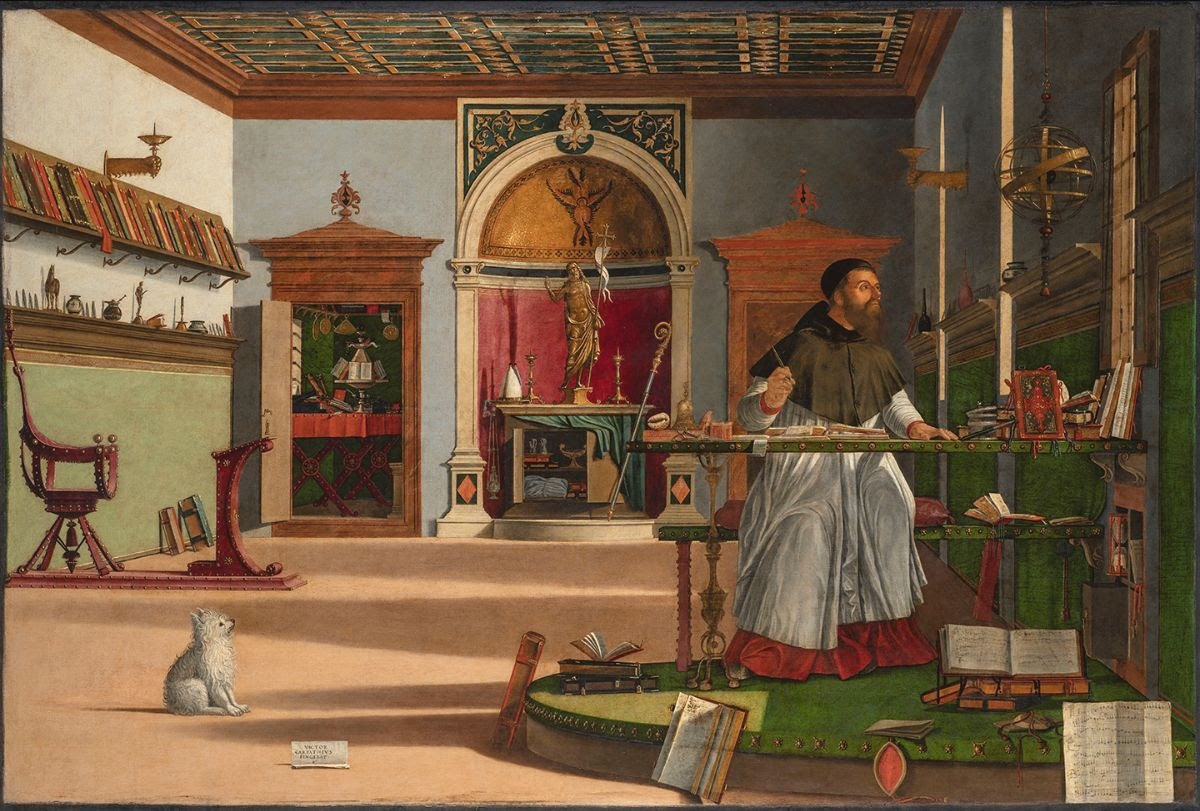
Carpaccio – St. Jerome in his Study

Fra Giovanni – The Mocking of Christ
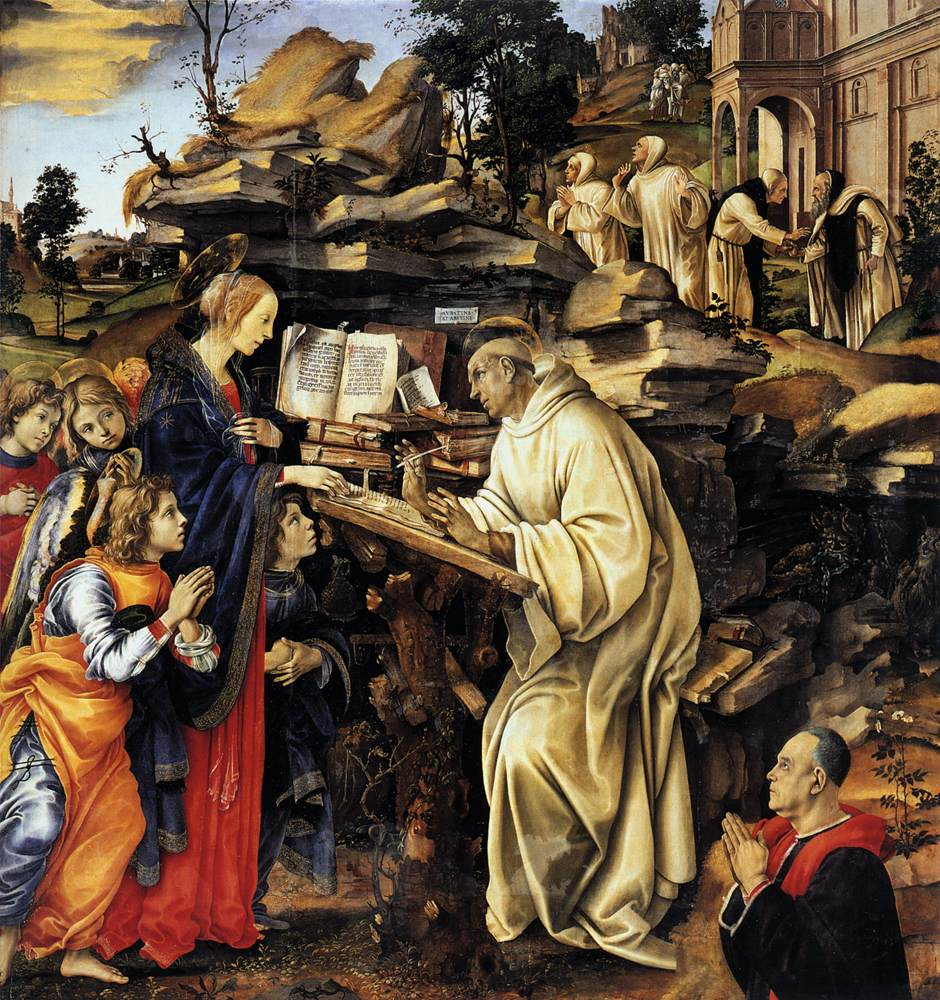
Lippi – The Vision of St. Bernard
A Schematic History
Perhaps more so than any other chapter of history, the Renaissance is fragmented. It's a complex tapestry of political intrigue, the flux of great historical events, and above all the actions and ideas of specific individuals. Most confusingly, these individuals move around constantly. To understand, for example, the story of da Vinci one must track the history of Milan, Florence, Rome, and a thousand other small states. Understanding Florence in this time calls for an understanding of the Medici family. Of course, the Medici family is composed of individuals who themselves moved around — one of them even became a Pope.
So the Renaissance is a complex graph that really defies one singular explanatory projection. The axis of time gives us a view of the Renaissance, but only if we already understand all the moving pieces.
Here I will attempt to organize the people, states, and products of the Renaissance schematically in a handful of different projections. We'll see how this goes.
By State-Ruler
- The Papal States
- Gregory XI
- Brings the Papacy back to Rome.
- Urban VI
- Combined efforts to reform the church and consolidate political power into Italy creates a Schism in which the French create a second Pope in Avignon (Clement VII)
- Boniface IX
- Schism continues.
- Squeezes a lot of money out of a Jubilee with unscrupulous practices. Puts down a republican revolution.
- Innocent VII
- The Three Popes: Gregory XII, Benedict XIII, John XXIII
- An ecumenical council is called in Pisa to resolve the Schism; they instead manage to create a third, independent, and very unmanageable pope in John XXIII.
- This even more unstable state of affairs languishes until HRE Sigismund calls another conference in Constance and convinces John to stand down.
-
Benedict still referred to himself as Pope until the very end on the family holdings in Valencia Gregory then outmaneuvers Benedict by offering to resign if he gets to run the conference to elect his successor. Benedict effectively leaves in disgrace. - The Great Schism is ended and Gregory gets Martin V elected.
- Martin V
- Martin's rule mostly was absorbed by shoring up the Papacy, fixing financial problems, bringing order to Rome, &c.
- Eugenius IV
- One of the few saintly Popes from this era, he winds up making many enemies just trying to fix Martin V's unsolved problems.
- Has to flee Rome for a while. Papal weakness allows the French to try to make a new Pope again. Catholicism seems ready to completely fall apart in another schism when our unlikely hero, the Turks, step in to fix things by threatening Byzantium.
- Eugenius maneuvers pretty cleverly to successfully, in only momentarily, merge the Catholic and Orthodox churches. Most orthodox leaders reject the merge and Byzantium falls anyways, but the legitimacy it brought was enough to reconsolidate the Catholic church under Rome.
- Nicholas V
- The first Renaissance Pope.