Sleep
Sleep is foundationally important. Everyone understands this at some level, but few (for many years myself included) actually act on that knowledge. The sorts of advantages that sleep automatically confers onto a living human are profound, but the very automatic nature of sleep leads many to ignore it as a topic of serious study and discipline. I personally only really started to take sleep seriously when my own ability to fall sleep was nearly jeopardized by what I now know to be bad habits.
With every passing year of technological and cultural innovation, fundamentals like sleep become less and less automatic. Fortunately, this is one aspect of a person's life that can be directly controlled. What follows are my notes on research, practices, and experimentation related to sleep.
The Circadian Rhythm
Sleep is inextricably linked in with the body's circadian rhythms. The methods by which the body keeps track of time is complex, but ultimately a sub-sub-sub-component of the brain called the suprachiasmatic nucleus (SCM) functions as a master clock. This clock itself constantly uses real-world environmental samples to stay accurate. The time it keeps is less hour-of-the-day and more position of the day-night cycle.
This clock governs the body's circadian rhythm, which itself can be visualized with the below graph*:
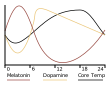
This presumes a cycle that starts with wake-up at 7am or so. Naturally the numbers at the bottom can shift.
This graph represents the normalized changes in melatonin, dopamine, and temperature and a well-regulated human's body throughout one circadian rhythm. The spike in dopamine wakes a person up naturally in the morning and the slow uptick of melatonin drives them to sleep in the evening. A lifestyle out of sync with this graph is responsible for many ills.
Influences
The SCM requires constant environmental cues to keep itself in sync with the turning of the Earth. So far, I am aware of two large categories that heavily influence or shift it:
- Optical light / dark cycles
- Dietary choices and timing
These will be explored further below.
Chronotype
Different individuals have differing 'peak' moments within their circadian rhythm at which they are most mentally alert and functional*. Colloquially the difference is reduced to the early bird / night owl dichotomy. However, this difference is more a continuum on which a person can land. Some of us are in the middle and can (by altering habits) effectively choose whether our best hours are in the morning or evening*. Others can be stuck in one way or another and an interesting study performed on ThyssenKrupp shiftworkers* shows the advantages to playing to one's chronotype.
Practice
So what can be done to practically improve sleep? It turns out it's pretty simple, but requires substantial discipline in our modern world. Here at the top I present a simple graphical representation of what's needed followed by deeper notes on the various aspects of life that effects sleep.
Diet
- Meal substance and timing.
- Meal richness should taper throughout the day. Breakfast should be large and rich, dinner should be simple and clean.
- Especially avoid fatty foods before bed.
- Avoid eating within two hours of regular bedtime. *
- It's best not to go to sleep thirsty, as thirst can wake a person up and make it difficult to fall asleep in the first place.
- Alcohol
- Known to disrupt circadian rhythm. *
- Caffeine
Light
In the field of light more than anywhere the modern world wreaks havoc upon our circadian rhythms. The electric light is an abomination that allows us to stay awake and productive during periods of time that our bodies simply did not evolve to do so in. Light pollution afflicts the Western world to an extent that 'dark sky parks' are as necessary as Yellowstone for preservation. Blue light more than anything is used by the body to set the SCM's timing and so artificial sources of blue light can upset this easily.
- Real darkness in the room at night is imperative.
- Gentle, tapered light in the morning really helps establish the latter end of the rhythm.
- Sunlight is ideal, but often not possible due to the very exertions required to keep the room dark at night (blackout curtains etc).
- Use of a software like f.lux to control blue light on a computer can allow a person to get productive computer work done in the evenings before bed without too much damage to the rhythm.
Now, real sunlight is a tricky beast to replicate. I plan to do fiddle with a custom sunlight-mimicing sunrise system later. This is a decent place to start looking at which products on the market effectively mimic the sunlight spectrum. The best plan for sunrise will involve two such bulbs each possessing a different 'light temperature'. One should be tailored to sunrise colors and the other to early morning. The former will power on first, and then taper off as the latter tapers on.
Melatonin
Melatonin is by and away the least harmful substance one can take to help fall asleep. However, it's really a tool to help shift sleep cycles rather than assist a person in falling asleep each night. It shouldn't be taken in the long term without first consulting a doctor for a tailored (and likely timed-release) prescription.
I myself took melatonin for nearly a year once and noticed appreciably better sleep in the weeks following the elimination of my nightly dose. Tapering the consumption down each night was very helpful.
- An official recommendation I've been able to find says that taking 0.25 to 0.5 mg of melatonin for a few days to reset a sleep schedule is just fine. *
- Melatonin's effect on the body functions more as a step function, so an 'overdose' won't help a person fall asleep faster.
- However, a substantial overdose can disrupt the circadian rhythm for a week or more. *
- The circadian rhythm will naturally cause melatonin levels to rise about 14 hours after waking up. *
- If a person awoke at 9am, this would have the pull of sleep naturally start at 11pm.
- Going back to sleep after an alarm for even five minutes can reset this 14-hour window by up to an hour and a half.
- More than anything, I've found personally that 'hitting snooze' will disrupt my ability to fall asleep on time the next evening.
- Interestingly, melatonin as a substance does much more than just regulate sleep. It has repair functions in the retina, antioxidant behaviors in bone marrow, and protective abilities in the gut. *
Naps
Naps are of questionable utility. Naps longer than 20 minutes are pobably damaging. Naps indeed might simply be an indicator that a person is not getting enough quality sleep at night. *
Indicators
When performing a self-study of sleep, the biggest challenge is collecting objective data on sleep quality. Here I document a couple flags and indicators I've read about.
Sleep quality is good / circadian rhythm is adjusted if:
- You wake up without needing an alarm.
- You feel awake when you wake up.
The following flags indicate poor sleep:
- The 'post-lunch dip' is proportional to sleep deprivation.